


Lightweight digital computers permit the system to eliminate the gimbals, creating strapdown system, and are called so because their sensors are simply strapped to the vehicle. In a strapdown inertial navigation system the accelerometers are rigidly mounted parallel to the body axes of the vehicle. In this type of system, the gyroscopes do not provide a stable platform. Rather, they are used to sense the turning rates of the craft. The computer determine the craft’s current velocity and position with the help of double numerical integration, combining the measured accelerations and the instantaneous turning rates and guide it along the desired trajectory.

This reduces the cost, eliminates gimbal lock, removes the need for some calibrations, and increases the reliability by eliminating some of the moving parts.
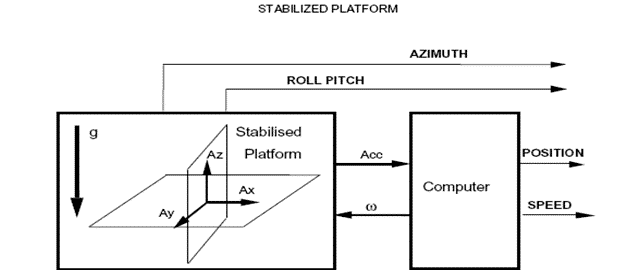
In other way we can understand the function of a strapdown system as :
A strapdown Inertial navigation system (INU) move with the body. Their gyros experiences and measures the same changes in angular rate as the body in motion. The strapdown INU’s accelerometers measure changes in linear rate in terms of the body’s fixed axes. The system body’s fixed axes are a moving frame of reference as it is opposed to the constant inertial frame of reference. Whereas, The navigation computer uses the gyro’s angular information and the accelerometer’s linear information to calculate the body’s motion with respect to an inertial frame of reference.
A strapdown system has a dynamic measurement range, several hundred times than a gimbaled system. That is, it must integrate the vehicle’s attitude changes in pitch, roll and yaw, as well as gross movements. Gimbaled systems could usually update at rate of 50 to 60 updates per second. However, strapdown systems normally update about 2000 times per second. The higher rate is needed to keep the maximum angular measurement within a practical range for real rate gyros i.e. about 4 milli radians.
Â
fizyta
Lovely site! I am loving it!! Will be back later to read some more. I am taking your feeds also.
v48avj
Very interesting subject, regards for putting up.
Very efficiently written post. It will be useful to anyone who employess it, as well as yours truly :). Keep up the good work – looking forward to more posts.
I like this weblog its a master peace ! Glad I detected this on google .
naturally like your web-site but you have to take a look at the spelling on several of your posts. A number of them are rife with spelling issues and I find it very bothersome to tell the truth nevertheless I will certainly come again again.
My wife and i have been very relieved that Louis managed to finish up his investigations out of the ideas he obtained through your blog. It’s not at all simplistic just to always be giving freely tactics which usually other people might have been trying to sell. We really discover we now have the writer to appreciate because of that. The type of explanations you’ve made, the straightforward blog navigation, the relationships you help to foster – it’s got everything extraordinary, and it is leading our son and us understand this subject matter is amusing, which is incredibly serious. Thank you for everything!
I¦ve recently started a site, the information you offer on this site has helped me tremendously. Thanks for all of your time & work.
I will right away take hold of your rss as I can not in finding your email subscription link or newsletter service. Do you’ve any? Kindly let me know so that I may just subscribe. Thanks.
I have not checked in here for a while since I thought it was getting boring, but the last few posts are great quality so I guess I’ll add you back to my daily bloglist. You deserve it my friend 🙂
I like your writing style genuinely enjoying this web site.
I like the efforts you have put in this, thanks for all the great articles.
I truly appreciate this post. I have been looking everywhere for this! Thank goodness I found it on Bing. You’ve made my day! Thank you again
**mitolyn reviews**
Mitolyn is a carefully developed, plant-based formula created to help support metabolic efficiency and encourage healthy, lasting weight management.
10 year fixed rate mortgages [url=https://otvetnow.ru]https://otvetnow.ru[/url] digital signature companies
Greetings from Los angeles! I’m bored at work so I decided to check out your blog on my iphone during lunch break. I enjoy the knowledge you present here and can’t wait to take a look when I get home. I’m amazed at how fast your blog loaded on my phone .. I’m not even using WIFI, just 3G .. Anyways, amazing site!
I like this post, enjoyed this one regards for putting up.
As I website owner I believe the written content here is real excellent, regards for your efforts.
Your point of view caught my eye and was very interesting. Thanks. I have a question for you.
I was just seeking this info for some time. After 6 hours of continuous Googleing, finally I got it in your site. I wonder what’s the lack of Google strategy that do not rank this kind of informative sites in top of the list. Usually the top sites are full of garbage.
Its superb as your other blog posts : D, appreciate it for putting up.